Showing posts with label Travel. Show all posts

Monday, 11 March 2019

The Karamajong, Uganda's Nomadic Warriors.

I remember when I was growing up, we heard stories about the Karamojong. I heard they lived a simple life, drank cow blood and had few possessions-- not even clothes. It was really interesting to hear all about this. When I saw them on TV I was intrigued.


A leader of a tribe. Photo by Paul. 

My client and two Karamajong warriors. 

The Karamojong have survived years of insecurity in north-east Ugan
da where they lived. There were disputes with cattle and herders owning guns to protect their livestock. I remember my teacher telling us the Karamajong believe all the cows
in the world belong to them. The disputes led to violence which led to loss of life. Some left the region out of fear for their safety. It was not until 2005 when the government outlawed guns that peace returned.

There are tons of cows in this region. 

Early this year I had the chance to visit the region with a client and it was unforgettable. We broke our journey in two by stopping over Sipi Falls and then continued to Moroto. It is not advisable to travel all this journey in one day. Moroto is a district in Northern Uganda about 405 km from Kampala going via Mbale.

Upon arriving we noticed the style of huts (manyatas) are different. They are small and the entrance is very tiny for security purposes. The Karimojong are naturally tall and skinny so entering their homes isn't an issue.

The tiny entrance into the Manyatta. 

A big food storage pot. 


A young boy milking a goat. 

The new generation of Karamojongs are clothed. Women wear hand- made woven skirts made from a blanket known as “Nakatukok” with unique jewelry. The men usually tie a blanket around their waistline topped with a vest or nothing above the waist if they feel like it. Their blankets are used to cover themselves overnight when they go grazing and spend the night in the kraal. They also have a special kind of a tiny wooden sitting stool they travel with used as a pillow or sitting.

Animals are very important when you live a nomadic life. There were tons of goats in the compound and the cows were out grazing. Usually livestock is used for transaction purposes. For example, if I want my child to go to school, I might as well hand in some goats instead of cash. The more cows you have, the more your wealth. You may also have more wives hence becoming a chief of the village.
A Karamojong diet includes milk, meat, cow blood and sorghum. Nothing sweet. No oils for cooking. You can't notice but wonder when you see seniors with strong teeth how much food consumption plays a part in their health.

The men tie a blanket around their waists.

Woven skirts by the Karamajong women. 

We were lucky when we arrived, it was the community get to together and dance. The dancing movement required lots of energy with high jumps! It’s kind of similar to how the Masai dance themselves. After 30 minutes we were exhausted!

Community games. 

The dance. 

The Cheerleader. 

We were taken to a Kraal where we had to spend a night with some nomadic warriors along with kids aged 4 to 10 grazing cows, sheep and goats. It’s believed teaching these skills to the youth prepare them to be responsible men. With our camp fire lit, we listened to stories while we stared at the sky, the stars were very bright with refreshing air. The next morning we woke up to a gorgeous sunrise behind Moroto Mountain! You cannot miss this. Be sure to be up by 6:20 am at the latest.


Our camp Fire. 

A kid having raw milk and fresh blood from a cow. 

Sunrise over Mt Moroto. 


We rode our bicycles to some other communities with Mount Moroto in the distance. I, myself, am not a good cyclist but we had a wonderful team of leaders who led us through the trails and were very concerned about our safety. It was a great work out for the day.

Having a rest after cycling. 

At the end of the trail. 

If you have more time, there are trails that you can hike on Mount Moroto where you can immerse yourself into the daily life of the Tepeth community who are believed to be the indigenous owners of the Karamoja savanna. How they’ve built their huts on top of the toppling rocks along Nadukon valley is a marvel.

 This Northern part of Uganda is rich in nature inhabited by a people who have not forgotten their humble roots. There is so much to do and experience! You’ll love it!

Friday, 15 February 2019

10 Do's and Don'ts in Kampala

Kampala is known as one of the busiest city in Africa and well as among the cheapest. The city is less populated with tourists  but it can be an interesting one to discover.

DON'T: Carry dollars printed Pre 2009.... 

Yes, I know it sounds ridiculous but no one will accept them. Make sure the dollar notes are crispy clean and not folded.

DO: Carry some cash with you at all times.....

Not all facilities accept payments by Visa cards like its done in the west. Most transactions are done by cash. Having some money on hand will save you sometime and frustration when they refuse your card.
Have some cash on hand.

DON'T: Get on a boda boda without a helmet.... 

I know you might be curious to use one of these bikes which is fun if you are using a good rider but you have to put your safety first. Accidents by boda's are common and nasty. Keep safe.

Keep safe.

DO: Experience the night life in Kampala.

Kampala has a reputation of having the best night life in the East African Region. People love to party and have a good time everyday. Check out some live bands, bars, clubs and performances in the city. I kid you not, you will not be disappointed. Who knows how many dance moves you will discover?

Kampala Walking Tour's Pub Crawl.

DON'T: Stop eating.... 

You have to try a Rolex before you get out of the city. It is Uganda's favorite snack sold every where on the street, its probably the cheapest Rolex you will ever have. And have you had our fruits? I will say no more. Betcha you just can't have one.

Our favorite snack.

DO: Keep your valuables in sight...

You should carry your bag in front of you and keep a hand on it. Keep your wallet and phone where you can watch or feel them all the time. Pickpockets in Kampala are very smart, so your valuables should be given the first priority once you are roaming around the city.

This is how you carry your bag in crowded areas.

DON'T: Miss out on the markets.....


Markets are always interesting areas to explore in Kampala. This will give you a little taste of our daily life.

One of Kampala Markets full of colours.


DO: Avoid the rush hour....

I don't know if you heard about Kampala's traffic jam but you do not want to get caught up in it. We do not have so many traffic lights which makes it worse.  Always do what you have you have to do and leave the city before the rush hour. If your last resort is the boda boda, remember the helmet.

Kampala Traffic Jam.

DON'T: Hunt for WiFi.......

Free WiFi is hard to find. Forget the internet and slowly feel this city which is overwhelmingly interesting in its own ways. You will not regret it at the end of the day. Stay electronically unplugged when you do not have to be.
Forget the WiFi, enjoy the city.


DO: A walking tour with Kampala Walking Tours........

What better way to discover the city with the first, best and original Walking Tour company in Kampala. This tour will take you from the Uptown, downtown and the suburbs. You will discover so much in a short time and you will learn more about the city and country. What better way to discover the city on foot one step at a time?

Enjoy and learn more with the fun guides.

Tuesday, 11 September 2018

From Phnom Penh to Kampot.


I left Banlung on a night bus which took forever to reach the Capital because of many unending stops. I arrived around 6 am on a rainy day and I was to look for my hostel. After refreshing, it was time to go wandering around the city.


Main roundabout in Phnom Penh.
Outside Wat Pho temple

First thing I visited was the Tuol Sleng Genocide Museum. This site was a former high school transformed into a prison from 1975-1979 under the Khmer Rouge Regime. In 1975, 2 million people were evacuated from Phnom Penh to do agricultural work in the villages and were introduced to Maoist and Marxist-Leninist ideology. The desire was to transform the country into a rural, classless society in which there were no rich, no poor, and no exploitation amongst the population. To achieve this, money was abolished along with free markets, private property, foreign clothing styles and religious practices. Schools, churches, Pagodas, universities , shops were shut or turned into prisons. The former penitentiary turned museum was the most important in the country, with 14, 000 prisoners during operation with only 12 surviving at the end of the genocide.

I also visited the Khmer Rouge Killing Fields where a huge number of people were executed. There are 20, 000 mass graves in which over 1.7M people killed during a four year period. When you walk through the fields, you can see some remains of the dead. The rain washes corpses to the surface with some clothes being visible from the ground in torture sites. By the end of this horror, Cambodia’s population was trimmed from 8 to nearly 6 million.


Tuol sleng genocide museum.

Killing tree where kids were executed in the killing field.

After having such a heavy day with sad history, I decided to go find something lighter to raise my spirits. I went to the Russian main market which literally sells everything. I bought a couple of souvenirs and some clothes. Later on I met some friends where we enjoyed a nice and cozy Japanese bar.
Chilling by the river.

Wat Pho Temple
Views of the city over Mekong river

My last day in the city was spent sightseeing some of the renowned spots. I visited the Wat Pho temple, a peaceful and serene spot with breathtaking history. The Independence Monument is lotus-shaped and was built to commemorate Cambodia’s independence from France in 1953. It’s located in a round-about, so be careful about crossing to take photos as it’s extremely busy. I walked outside the Royal Palace but did not pay to enter as I had already seen the Grand Palace in Bangkok. When you travel on a budget, you have to be discerning with your expenses.


Public work out near the Mekong River.
My final moments were spent strolling alongside the Mekong River. The vibe here is really nice because there is a lot going on. There’s cafes, restaurants, bars, as well as people exercising with music in a public space. I just sat in one of the benches by the river as I read a bit and people watched. It was a nice way to end my last day in the capital.


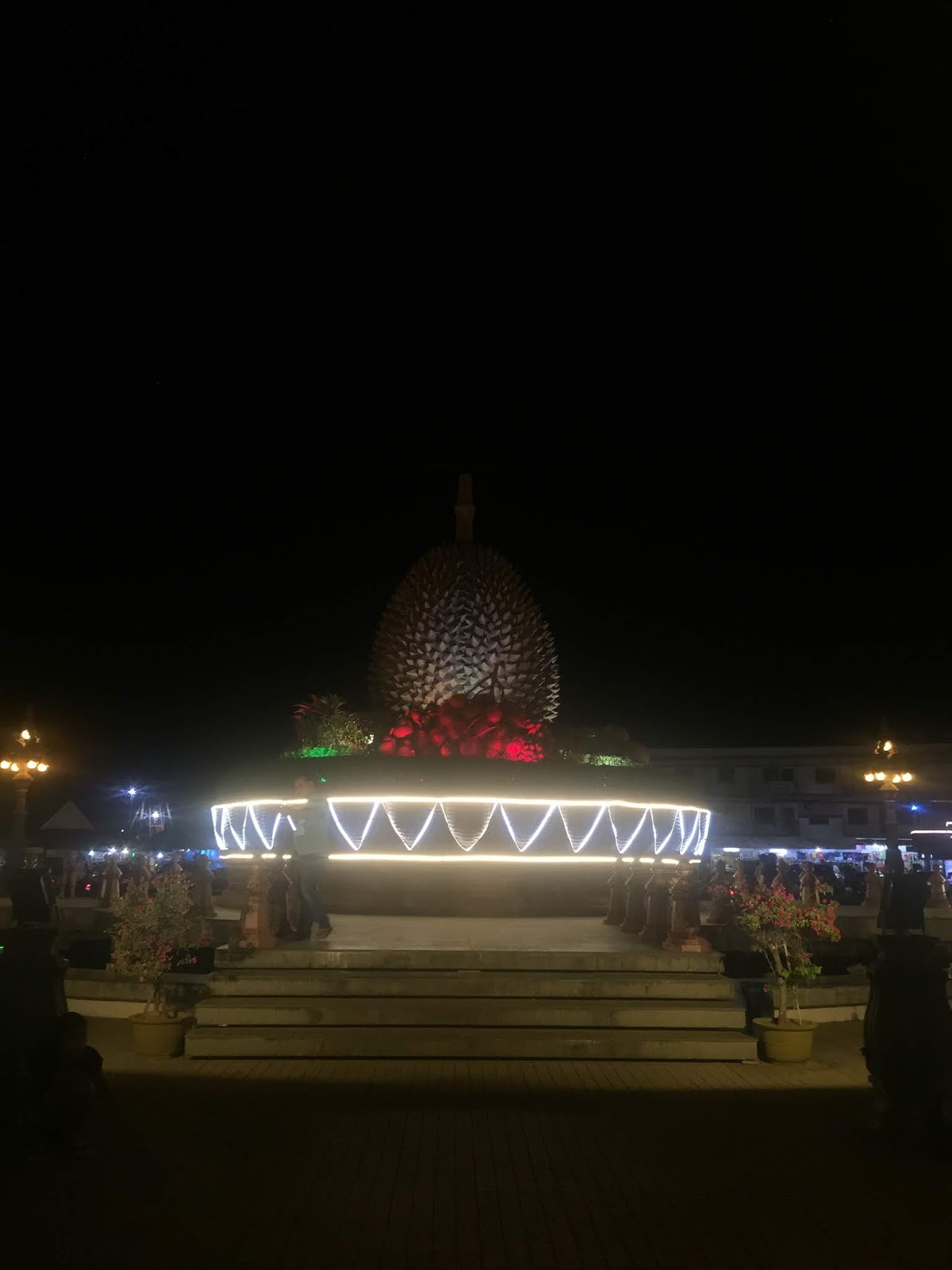
Duran roundabout at night.

A street in Kampot.
Famous bridge in Kampot from the old city to the new one.

My final moments were spent strolling alongside the Mekong River. The vibe here is really nice because there is a lot going on. There’s cafes, restaurants, bars, as well as people exercising with music in a public space. I just sat in one of the benches by the river as I read a bit and people watched. It was a nice way to end my last day in the capital.

My last stop in Cambodia was Kampot. This is a very charming and quaint town with a touch of French colonial influence. It is very easy to walk around and the sunset by the river is so amazing. Its claim to fame is a high quality pepper and fish sauce which they export.

On my first day in Kampot, I arrived in the afternoon and checked into my hostel and proceeded with what I like to do most, walk around. There is a street food place which is very cheap. I had a quick lunch and then went on to sightsee. One side of the river has a great deal of colonial architecture surrounded by a number of delightful cafes and shops. After looking around I went by the river to chill and enjoy the sunset. Night time was for checking out the night market. Nearby was a big durian shaped round about which looks nice at night with light. I ate some food at the market and then walked around but most of the clothes sold here were more modern than the usual markets I was used to. Before I went to bed, I booked a day tour at the Bokor Mountain National Park for the following day.

Outside one of the coffee shops.
Coffee shop.

Sunset in Kampot upon Mekong River
We had a lot to see in just one day! It was very foggy in the morning, even when we soared above the clouds. The view of Kampot from the top was like a painting. Then we proceeded to discover Bokor Hill Station, a luxurious mountain top resort constructed in the early 1900’s which now serves as ghostly remnants of the past. There were a number of abandoned French colonial ruins as well as a big welcoming Buddha and a church which belonged to the King. During the rainy season a waterfall is located nearby with a towering pagoda that provides an extensive view of Mother Nature’s beauty.


Sitting in one of the former french colonial buildings.

Former french  ruins.

The abandoned former French Bokor hotel and Casino.

Above the clouds from the Pagoda.
The view of Vietnam over the lake.

We wrapped up the day looking for fireflies on the river but I think my expectations were too high. Only saw a small number of them but it was still special. Don’t forget the mosquito repellent for the boat ride. That was a wrap up for me in this town but there is more to see like majestic caves, a day tour to Kep, beautiful beaches, salt fields and bike rides if you fancy a leisurely stroll on two wheels.

Monday, 13 August 2018

An Insider's perspective on African Travel


 While I may run a tourism business, that does not mean that I do not enjoy playing the part of the tourist as well. I very much believe that to provide a quality experience to my customers, the best way for me to do that is by periodically putting myself in their shoes. I personally got bitten by the travel bug long ago and so, like many of my clients, am constantly looking for the next expedition. Unfortunately for Ugandans, visas for countries on other continents can often be expensive and hard to obtain. Given that fact, and also the added expense of traveling further afield, I resolved to see, at the very least, one new African country every year.
The hike was worth it.

African penguins

Drakensberg amphitheater is regarded as one of the most impressive cliff faces on earth.


Africa is the world’s second largest continent by both land and population and has no shortage of places to see and experience. There are a lot of different things to do when you arrive on the continent like gorilla trekking, mountain climbing, safaris, white water rafting, desert safaris, kayaking, swimming with dolphins and whale sharks, scuba diving, and sky diving. Just like any traveler, I want to experience the diversity of adventures which are available, and take it from an African that not all African countries are the same. Every nation you visit displays its own unique cultures, languages, and ways of life. In my most recent trips, I traveled through East and southern Africa, to the Seychelles, Mozambique, Malawi, Rwanda, Ethiopia and South Africa and felt just as much a foreigner (and just as much excitement) as someone from Europe or the US.. 
Dalol lake in Ethiopia
Salt Flats in Ethiopia.

The volcano is an amazing site.
Despite having given hundreds of tours and interacted with thousands of people from all over the world, I still find it interesting to hear the responses of clients when questioned about their conceptions prior to arriving. I continually hear comments such as “I thought it was like a desert”, “I didn’t know my iPhone would work here”, “People are dressed more modern than I expected”, “It feels safe here and people seem friendly”...etc. It is actually rare to encounter someone who is NOT surprised at what they find upon finally touching down. 
Colonial streets on Mozambique island

Floating on the Indian ocean- Paradise!

Empty quiet beach in Mozambique
  With all of that said, and while I may be somewhat biased, it is not an exaggeration to say that within Africa, Uganda continues to be one of the favorite destinations of travelers from around the globe. The people here are very friendly, and its capital Kampala ranks among the most inexpensive cities in the world. Additionally, our temperature remains relatively the same year-round, providing travel opportunities in all months. The vegetation is always lush and green, and there are always things to do.
Wild life in Tanzania.


Beautiful Usamabara mountains in Tanzania.

Kampala Walking Tours has the privilege to guide you on our customized journeys replete with knowledge and history. We offer a wide variety of activities to suit your interests with some of our offerings including: walking and cycling tours focused on the city, food, and entertainment, respectively; day treks to the equator, rhino sanctuary and the source of the Nile River; safaris in the wild; gorilla and chimpanzee spotting; white water rafting; and hiking trips. While my business is constantly evolving, our passion remains constant - to give you the most unforgettable experience in East Africa.
The mighty Gorilla- Photo by - Nils.

Lake Bunyonyi in Uganda- Photo by- Nils.


Fresh fruit and Vegetables on the continent.


This is not to downplay the challenges involved. Like any trip, before travelling, you should do your research for each country. For example, it is easier to move around Uganda because English is the official language and almost everyone speaks it. In Mozambique, on the other hand, you would do well to learn some basic phrases in Portuguese with the same going for Swahili in Tanzania, and Amharic in Ethiopia. While Africa in general is relatively cheap, good research will still save you money as we have tourist traps just like anywhere. For backpackers, there are myriad low-cost options with hostels and tent sites scattered throughout the continent. If you’re a hard-core adventurer, you can even rent or buy a motorbike and ride from South Africa to Kenya, as several of my clients have done. And of course, there are the more well-known group safaris which can be booked as a good way to share costs. Public transport is available in most countries, and you can always find cheap food in every place you go. 


A few things to remember when moving around Africa:

  • In most African countries, people don’t wear clothing that exposes the body, especially the legs, so it is usually more appropriate for men to wear long pants and women to wear something that falls below the knees 
  • Travelers should avoid carrying large amounts of cash, and try to make use of Visa cards as much as possible, as these are accepted in many towns and cities.
  • When taking photos of people, always ask their permission first. 
  • Make an effort to learn some basic local phrases as it shows respect and has the added benefit of helping you get better prices. 

Of course, as with many experiences, there is only so much you can learn from reading. At a certain point, you just have to take the plunge. So if you want to know what this wonderful continent is all about, turn off the TV, book your ticket, and come experience it for yourself. I look forward to seeing you!